On-Demand Mobility: A key solution for Building Inclusive and Accessible Cities
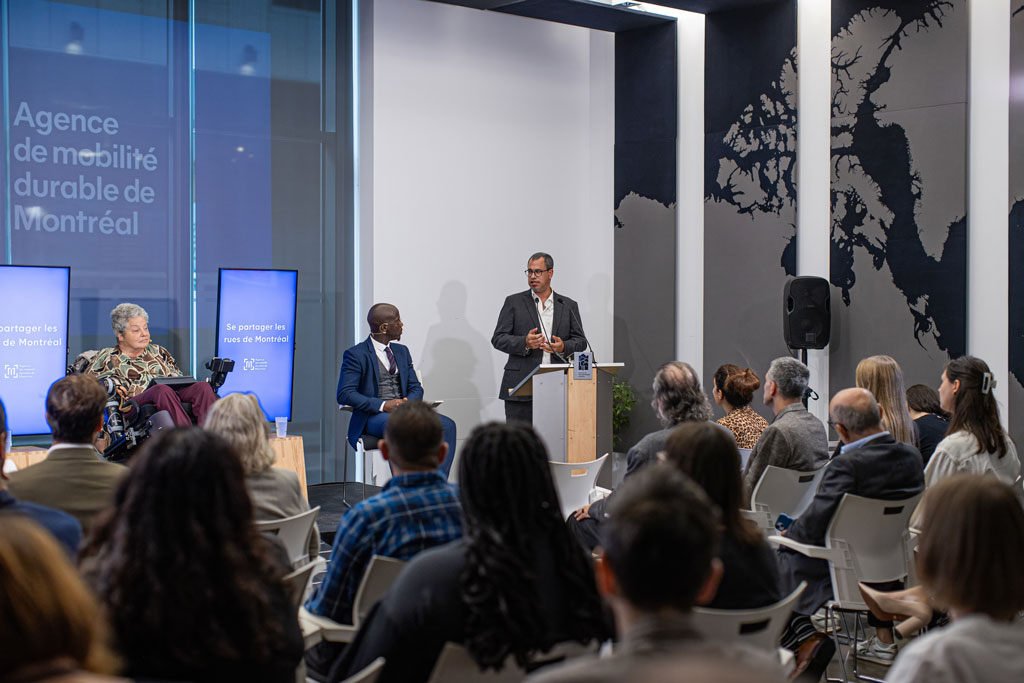
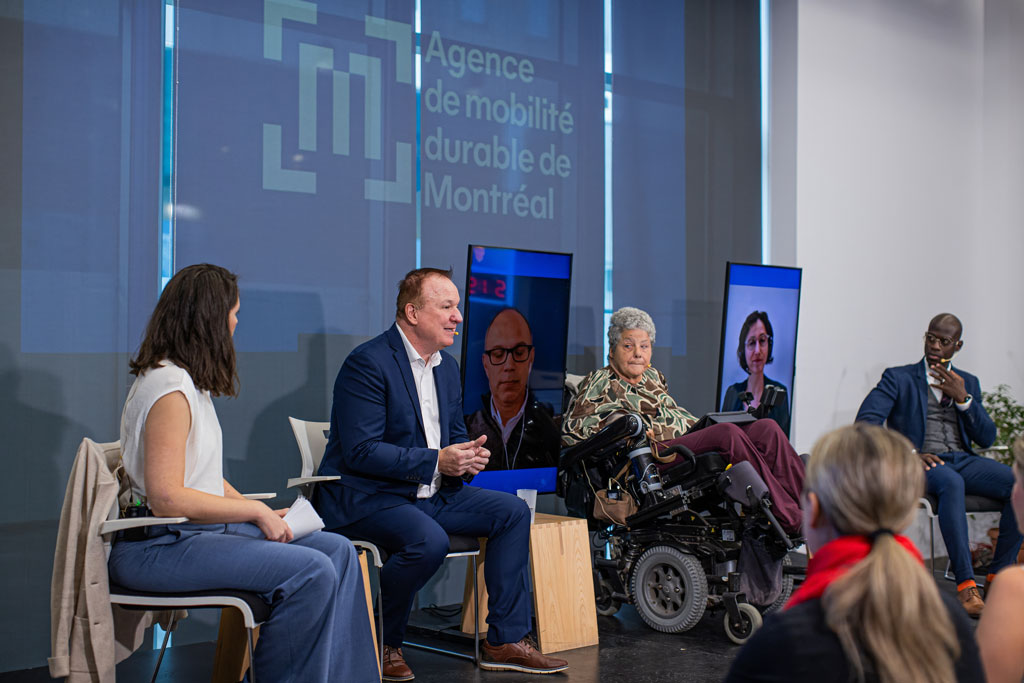
The 8th edition of our expert panel did a deep dive into on-demand mobility. 5 specialists from Canada, Europe and Africa discussed not only its social and economic benefits but also the challenges of integrating it into the sustainable transportation offering.
Our panelists

President of the Board of Directors, Kéroul

CEO, Vulog

CEO, EGWAY

Head of Multimodal Mobility Unit, International Association of Public Transport (UITP)

Director of On-Demand Mobility, Agence de mobilité durable de Montréal

Moderator
What is on-demand mobility?
Sylvain Tousignant began by explaining that the term refers to modes of transportation that complement public transit with fixed or planned routes. He cited taxis, limousines, chauffeur-driven vehicles, car sharing, paratransit and bike sharing.
Lidia Signor added, “It’s sustainable mobility. It’s good for people but also good for society and the planet.”
Progressing toward fairer mobility
Primaël-Marie Sodonon clarified a vital point: On-demand mobility isn’t limited to areas served by conventional public transit; rather, it enables people to travel throughout a territory.
Gregory Ducongé added that the key word when we talk about on-demand mobility is “flexibility,” because it allows us to go where we want, when we want. He summed it up: “The goal is to make it easy for people to get where they want to go without the need for personal vehicles.”
Isabelle Ducharme pointed out that these flexible modes of transportation help make mobility more equitable for the entire population, whether young or old, rich or poor, with or without a disability: “They complement the existing offering.”
Integrating sustainable mobility into the public transit offering
According to Lidia Signor, much work remains to be done to ensure people can easily combine public transit and on-demand mobility to meet their needs. To that end, the panel’s specialists proposed a number of solutions.
Gregory Ducongé stressed the digitization of transportation as well as the need for standardized, open data.
Lidia Signor added that sustainable mobility infrastructure has to be physically integrated into the public transit system. She cited the example of mobility hubs: places where a range of sustainable transportation services can be accessed, such as bike sharing, electric charging stations and car sharing.
At the beginning of the panel, Laurent Chevrot, the Agency’s Executive Director, announced that the City of Montréal planned to develop 150 hubs by 2050.
Financing sustainable transport
Sylvain Tousignant and Primaël-Marie Sodonon opined that funding on-demand mobility services is a shared responsibility, citing the private sector on the one hand, with taxis and car sharing, and the public sector on the other, with public transit largely financed by the various levels of government.
“That being said, we must always keep the user-pay principle in mind: We don’t pay the same price for each service we use,” said Sylvain Tousignant.
According to Primaël-Marie Sodonon, “At the end of the day, what we’re looking for is the best service for customers at a level of affordability that will convince them to opt for public transit in all its forms and modes rather than locking themselves into solo car ownership, which costs more in the long run.”
Gregory Ducongé thinks that, in large cities at least, on-demand transportation has to develop business models that don’t depend on public funding to ensure profitability and sustainability. “Subsidies last for only so long,” he pointed out. “The day the subsidies end, so does the service.”
Isabelle Ducharme reminded everyone that funding has to be provided for inclusive services, such as vehicle adaptation, compensation for taxi rides transporting people with reduced mobility and diversity training for employees.
On-demand mobility: success stories from 3 continents
Lidia Signor said that a good way to measure the success of on-demand transport is its ability to serve the entire network outside the city, citing Hanover, Germany, and Bilbao, Spain, as examples.
Primaël-Marie Sodonon talked about initiatives in sub-Saharan Africa to map the informal transportation system, such as the Digital Matatus Project in Kenya.
Gregory Ducongé emphasized that the success of the various on-demand mobility services depends on the entire mobility ecosystem. He cited the city of Lyon, where operators offering self-service bicycles and scooters, as well as car sharing, work closely with public transit officials.
Sylvain Tousignant drew attention to Montréal’s Taxi Registry, a platform that collects real-time data on the location and status of all taxis in service on the territory. Last year, the Registry was integrated into Transit, a multimodal trip planner that combines public transit with a large portion of on-demand transportation.
“Creating synergy between on-demand mobility and public transit means people can get around more easily and, above all, more efficiently,” he concluded.
The panel in pictures